Social Proof on a Summer Street
October 4, 2025
A tiny shop, a long line, and a simple lesson in social proof
TL;DR : Small shop + busy street = visible line. Social proof makes us join. The line becomes the product.
Last week I spent a few days in Málaga with my partner and her family, and one simple takeaway stuck with me. One night we walked by the port, crossing Alameda Principal and Plaza de la Marina. On one of those streets we found a tiny shop selling artisanal frozen Greek yogurt with kefir. You could add granola, pistachio, chocolate—basically anything you want.
(I’ll keep the shop anonymous. The name adds nothing to the analysis and might bias your decision to visit.)
I usually check Google reviews before trying a new place. This one had about 80 reviews, so probably new. Yet every time we passed, there were 15–20 people in line.
First guesses?
-
Maybe the flavor was new or unique.
-
Maybe they were giving it away for free.
-
Or maybe everyone was in the mood for a yogurt those days.
After trying it, I ruled both out: it was very sweet—lots of sugar—and the yoghurt itself had little flavour. Fine, but nothing special. So quality and novelty didn’t explain it.
Why the long queue? Just ten metres away, there was a Llaollao with no queue, yet people kept joining the Greek yoghurt shop.
A better question might be: why do people choose to join the queue at the Greek yoghurt shop and wait 20 minutes—for yogurt—when Llaollao has no queue? Why did we?
A line by design
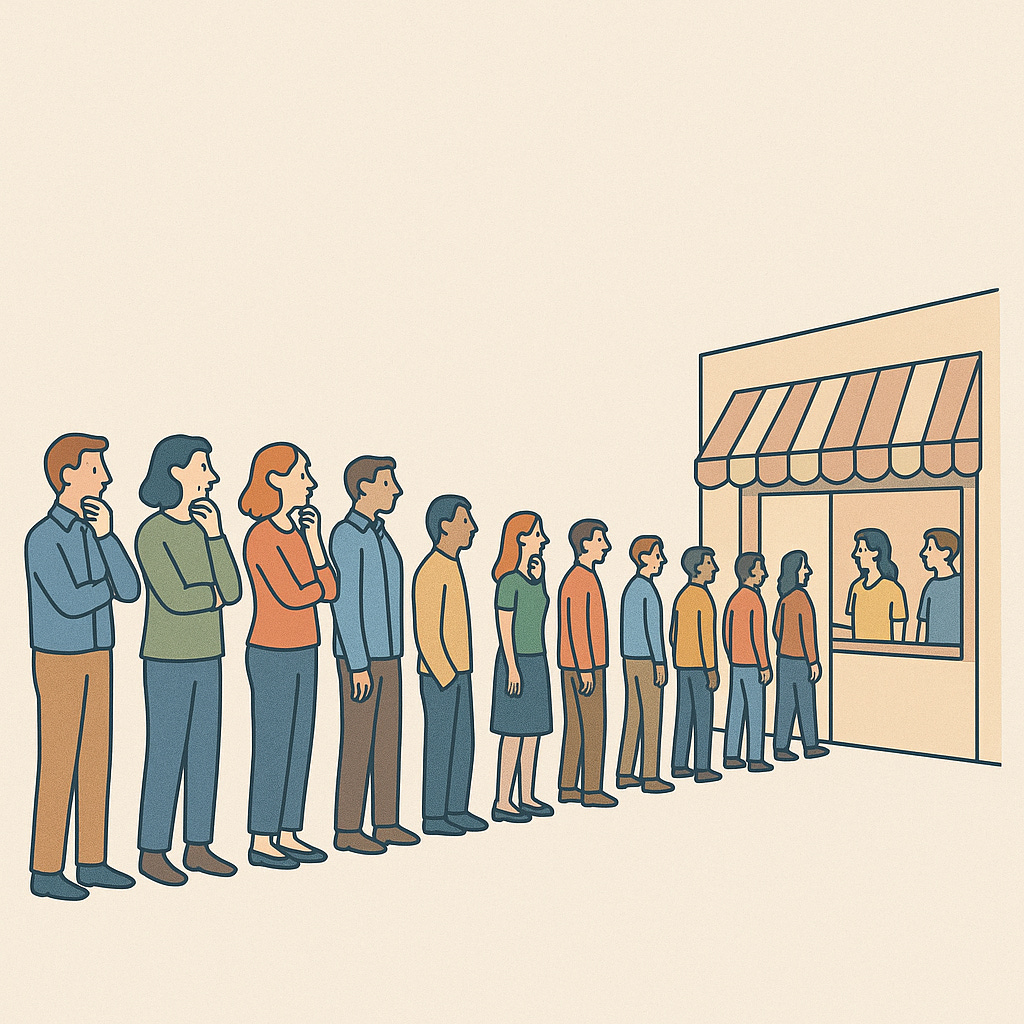
You can’t force a queue, but you can make one likely. A very small shop + limited counter space + slow enough service = a line that spills into a busy pedestrian street. In summer, that street is full of foot traffic, with ice-cream parlors, clothing stores, and more. A perfect mix—yet no other place had a line like this.
The space is so small that if two people order at the counter, everyone else must wait outside. The line stretches across the pavement. You can’t miss it. And that is the point: the line is the advertisement.
Social proof in action
Robert B. Cialdini’s idea of social proof fits perfectly here: we often decide what to think and do based on what others think and do. A visible line signals that “something good is happening,” even if we don’t know what. We treat other people’s actions as a cue for what is right or desirable.
People don’t want to be the first; they want to be right.
And they often outsource that judgment to the crowd.
In a tourist area, this effect is even stronger. If you don’t know the place, you trust visible signals from others. Simply put: we like to follow the crowd.
Design cues that amplify the effect
The shop also leaned into an instagrammable look: a wall of Mediterranean-style ceramic cups on one side and a large red-flower installation on the other—begging for photos. A man in his 60s even stopped to photograph it without joining the line, as if it were part of Málaga’s cultural heritage. The visuals help the queue sell itself.
What I learned
-
Don’t trust the crowd by default. A long line often has little to do with product quality—or with what deserves your time and attention.
-
Do your own check before you commit. Otherwise, you’re stepping into the social proof trap.
Related ideas that reinforce this: FOMO (fear of missing out), space design (engineering bottlenecks), and the Halo Effect (we read “long line” as “high quality” or “on trend”). Still, the dominant driver here was social proof—the line itself.